
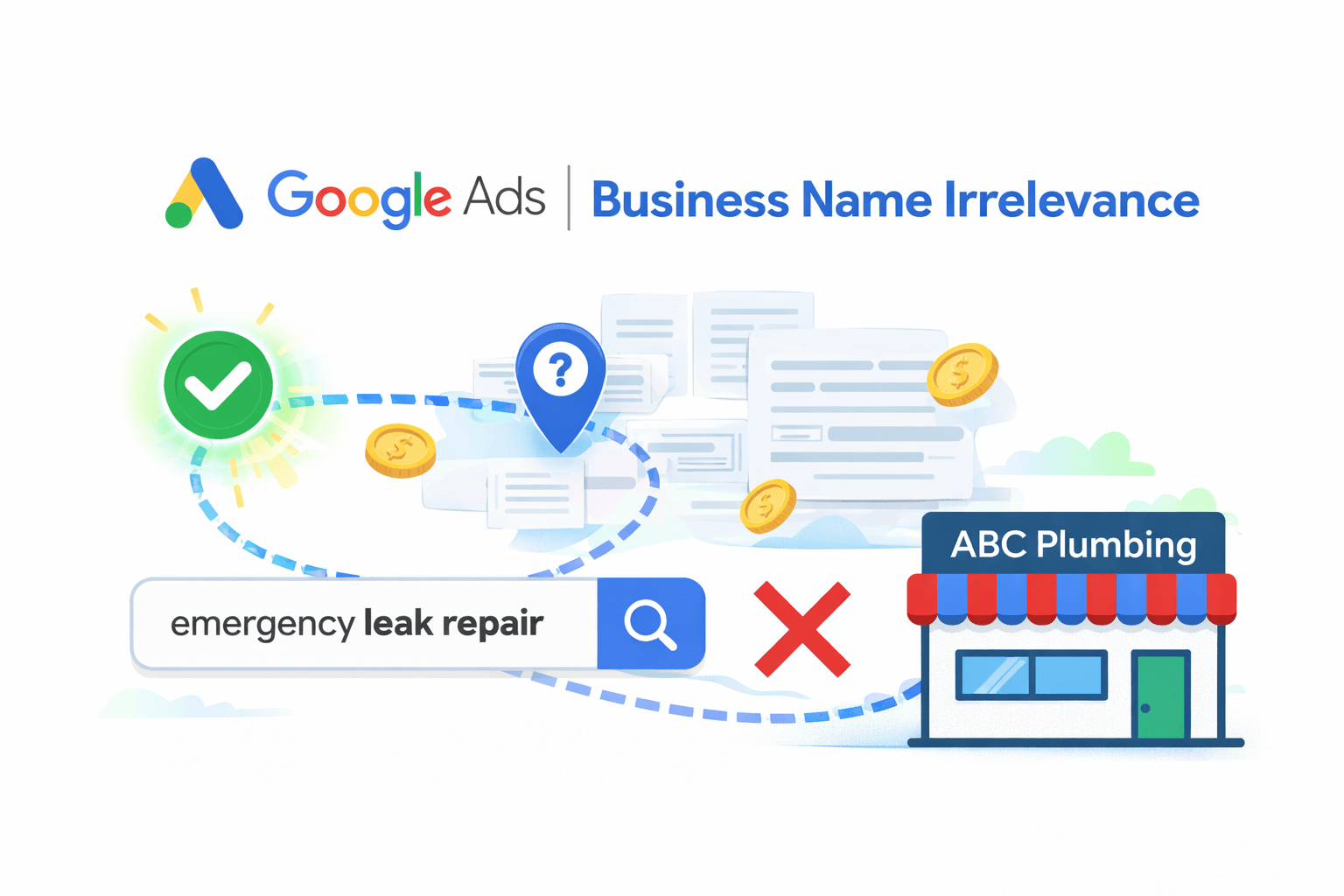
If you’ve logged into your Google Ads account recently and spotted a new “Business Name Irrelevance” warning, you’re not alone. Thousands of advertisers and agencies are reporting this issue across the platform, and it’s causing real disruption to campaign management.
Here’s what changed, why it matters, and how to navigate this frustrating policy shift without letting it derail your PPC performance.
What Is “Business Name Irrelevance”?
Google Ads has always had a 25-character limit for the Business Name asset. That’s not new. What is new, however, is the stricter enforcement of exact matching between your business name asset and your verified Google Business Profile name.
Previously, advertisers could use reasonable abbreviations or shortened versions of their business names without issue. “Full Circle Search Engine Marketing” might be shortened to “Full Circle SEM” in your ads. Google understood the constraint and allowed practical workarounds.
Not anymore.
Now, if your Business Name asset doesn’t exactly match your verified business name (character for character), Google flags it as “Business Name Irrelevance.” The result? Your ad strength indicators show as incomplete, and your business name may not display consistently across your ads. For anyone trying to manage Google Ads business name limits while maintaining brand consistency, this creates a frustrating technical barrier.
Why This Matters for Your PPC Performance
When managing PPC campaigns across dozens of client accounts, this isn’t just an annoyance. It’s operationally painful.
Here’s the reality: agencies are now forced to review the same “Business Name Irrelevance” warning across multiple campaigns, multiple clients, and multiple account structures. What should be a simple asset setup has turned into ongoing maintenance and internal discussions.
The Operational Impact:
Workflow Disruption at Scale
When you’re managing 30, 50, or 100+ client accounts, a single policy change multiplies exponentially. Teams are spending hours auditing business name assets across entire portfolios, only to find that the “fix” requires coordinating with clients to update their Google Business Profiles, then waiting for verification, and then re-syncing assets. This isn’t a one-time task. It’s a recurring friction in day-to-day PPC management.
Ad Strength Signals Disappear
Google’s ad strength rating helps optimize performance. When business names are flagged, you lose visibility into whether you’re meeting best practices, even if your PPC ad strength is otherwise solid. Account managers are fielding the same client questions repeatedly: “Why is my ad strength incomplete?” “Why isn’t my business name showing?” Meanwhile, your team knows there’s no practical solution for businesses with names over 25 characters. You’re stuck explaining platform limitations instead of optimizing campaigns.
Inconsistent Branding Across Portfolios
Business names may not appear in ads as intended, weakening brand recognition across search campaigns. For agencies managing brand consistency across multiple touchpoints, this creates additional quality control challenges.
Support Escalations Lead Nowhere
Teams are opening support tickets, documenting issues, and escalating to Google reps, only to receive impractical guidance like “rebrand your business to fit the limit.” This wastes billable hours and erodes confidence in platform support.
For agencies trying to scale efficient PPC management, this creates unnecessary friction that compounds across every account you touch.
The Gap Between Policy and Reality
Here’s where it gets absurd.
Google’s enforcement of this policy essentially demands that thousands of businesses worldwide rebrand to comply with an arbitrary 25-character limit. Every law firm with “& Associates.” Every regional business has a geographic identifier. Every franchise has standardized naming. Every established company has been operating under the same legal name for decades.
Google is basically saying, “Change your business name or accept incomplete ad performance.”
When support reps suggest rebranding as the solution, they’re revealing a fundamental disconnect. You can’t simply rename your business without considering legal filings, brand equity, franchise agreements, professional licensing, and decades of customer recognition.
For established businesses, this isn’t just impractical. It’s impossible. And yet, that’s the “solution” being offered.
This highlights the core tension: automated systems enforcing blanket rules without accounting for business reality. The 25-character limit always existed, but Google previously allowed reasonable abbreviations. Now, rigid enforcement creates a problem affecting countless businesses, with no practical path forward except waiting for Google to fix what they broke.
What You Can Do Right Now
Here’s the truth: you can’t fix this. This is a platform failure, not something agencies or advertisers can solve.
If your business name is under 25 characters and matches your Google Business Profile exactly, you’re fine. Everyone else? You’re waiting for Google to fix this.
Some support reps suggest rebranding your entire company to fit the limit. That’s absurd. Change your legal name, business licenses, and brand equity because Google’s algorithm can’t handle abbreviations it previously accepted?
You can update your Business Profile, monitor actual performance metrics, and document support conversations. But none of those fixes is the core problem.
Google needs to fix this. Their enforcement doesn’t account for real business names, legal requirements, or practical reality.
Until then, focus on conversions and ROI. Don’t let broken platform indicators distract from real performance.
The Bigger Picture
This Google Ads business name irrelevance issue reflects a broader challenge in digital advertising: balancing automation with flexibility. Google Ads continues pushing toward AI-driven campaign management, but rigid policy enforcement undermines the nuanced decision-making that successful PPC advertising requires.
At Full Circle SEM, we’ve managed millions of dollars in advertising spend across hundreds of accounts. We’re Google, Bing, and Facebook certified because platform expertise matters, especially when sudden policy changes threaten campaign performance.
This particular issue will likely evolve. Google has a track record of adjusting policies when widespread advertiser feedback demonstrates legitimate problems. Until then, staying adaptable and data-focused remains your best strategy. Don’t let incomplete PPC ad strength ratings distract you from what actually matters: conversions and ROI.
Don’t navigate platform changes alone. If you’re navigating these challenges and want an experienced partner, learn more about our approach.
